City in Dalmatia – Split

Split

Best time to go
May, June, Sept, Oct
Part of
Dalmatia – Split

01 · Overview and trip planning

Why visit Split

Split is the rare city where a Roman monument is not fenced off but lived in.

The emperor Diocletian built his retirement palace here around 300 AD, and the town later grew inside its walls, so laundry lines, cafés and family flats now share the stones with temples and a cathedral that was once his mausoleum.

It is also a working city of around 160,000 people, with a football club locals treat like a religion, a morning market, a busy port and a pine-covered hill at the end of the peninsula. That mix is why Split works for a short city break and as a base: the ferries to Brač, Hvar, Šolta and Vis leave a few minutes' walk from the palace gates.

Best reasons to go

  • Walk through a UNESCO-listed Roman palace that is still a neighbourhood, not a museum.
  • Swim in town: Bačvice is a sandy city beach and Marjan hides quieter pebble coves.
  • Island-hop without a car: ferries and catamarans leave from the edge of the old town.
  • Eat proper Dalmatian food, from day-boat fish to slow-cooked pašticada.
  • Easy day trips to Trogir, Klis Fortress, Krka National Park and the Cetina river.
Who it suits
First-time visitors to Croatia, couples on a city break, island hoppers who need a base, history lovers and anyone without a car. Families do well too if they stay near a beach rather than inside the palace walls, where nights are loud in summer.
How long to stay
Two full days covers the palace, Marjan and a beach. Give it three or four if you want day trips or an island, and use it as a base for a week if you plan to hop between islands.
Best time to go
May, June, September and early October: warm sea, long evenings and fewer cruise crowds than July and August. Midsummer is hot and busy but lively, with open-air opera on the Peristyle during the Split Summer Festival. Winter is mild and quiet, with shorter ferry timetables.
On a Croatia trip
Split sits in the middle of the Dalmatian coast, so it slots between Zadar or Šibenik to the north and Dubrovnik to the south. Most people pair it with one or two islands (Brač and Hvar are the closest), then continue to Dubrovnik by road or catamaran.

02 · Best things to do

Top things to do in Split

Ranked by what matters most on a first visit.

  1. Diocletian's Palace

    2–3 hoursFree to walk; some monuments ticketed

    Start at the Peristyle, the colonnaded courtyard at the heart of the palace, then step into the round Vestibule, where klapa singers sometimes perform in summer. Wander the lanes towards the four gates: Golden, Silver, Iron and Bronze. The streets are free and open day and night, so come back after dark when the stone glows under the lamps.

    Split Tourist Board: Diocletian's Palace

  2. Cathedral of St Domnius and its bell tower

    1 hourAbout €7 with the bell tower

    The cathedral was Diocletian's own mausoleum before it became a church, which makes it one of the oldest buildings in the world still used as a cathedral. Climb the Romanesque bell tower for the best view over the palace roofs and the harbour; the steps are steep and narrow near the top.

  3. The palace cellars

    45 minutesAbout €10 for the side halls

    The vaulted halls under the palace kept the emperor's floors level and today show the original layout better than anything above ground. The central passage from the Riva is free and lined with craft stalls; the side halls are ticketed. Game of Thrones fans will recognise them as Daenerys's dragon dungeon.

  4. Marjan hill

    Half a dayFree

    Split's green lung covers the tip of the peninsula. Climb the steps from Varoš to Vidilica café for the classic view over the city, then carry on through the pines to Telegrin, the 178 m summit, or follow the shore path past small chapels, including St Jerome's, built into the rock.

  5. Bačvice beach and a game of picigin

    A few hoursFree

    A sandy, shallow bay ten minutes' walk east of the palace. It is where locals play picigin, splashing to keep a small ball in the air without letting it touch the water. It gets crowded on summer afternoons, so go early or come in the evening when the bars open.

  6. The Riva and the old squares

    1 hourFree

    The palm-lined waterfront is Split's living room, best for a morning coffee or an evening walk. Behind it, Narodni trg (locals call it Pjaca) and Fruit Square show the Venetian-era town that grew beyond the palace walls.

  7. Meštrović Gallery

    1–2 hours€12 with Kaštilac

    Croatia's best-known sculptor, Ivan Meštrović, built this villa below Marjan as his summer home. His bronzes and marbles fill the rooms and the sea-facing garden; the same ticket covers Kaštilac, a short walk away, with his carved wooden panels of the life of Christ.

    Meštrović Museums

  8. Gregory of Nin statue

    10 minutesFree

    Meštrović's giant bronze of the 10th-century bishop stands outside the Golden Gate. Rub his big toe, polished gold by millions of hands, for luck.

Rather go with a local guide? See guided tours of Split on GetYourGuide.

03 · Hidden gems and local experiences

Split beyond the classic sights

  • Varoš

    The old fishermen's and farmers' quarter west of the Riva: steep stone lanes, washing between windows and small konobas. It is the easiest way to see how Split lived before tourism.

  • Matejuška

    The little fishing harbour at the west end of the Riva, where boats still unload and locals sit on the harbour wall at sunset with a drink.

  • Sustipan

    A quiet park on the headland beyond the port, once the city cemetery, with benches facing the islands. A good spot for an evening walk away from the crowds.

  • Kašjuni and the Marjan coves

    Kašjuni is a pebble beach on Marjan's south side with clear water and pines behind it. Along the shore path you will find smaller rocky platforms where locals swim.

  • Firule and Ovčice

    Small neighbourhood beaches just east of Bačvice, used mostly by people who live nearby. Calmer than Bačvice and a short walk further.

  • Pazar in the morning

    The open-air market by the palace's east wall is busiest early, when farmers from the hinterland and the islands sell figs, cheese, olive oil and lavender. Go before 10 am.

  • Salona

    The ruins of the Roman provincial capital, with an amphitheatre and early Christian basilicas, lie in Solin just outside Split. Few visitors make it, so you can often have the site nearly to yourself. City bus 1 runs there.

  • Hajduk at Poljud

    Seeing Hajduk Split play at Poljud stadium, with the Torcida supporters singing behind the goal, tells you more about the city's character than any museum.

04 · Where to eat and drink

Eating and drinking in Split

What to order

Pašticada
Beef marinated and slowly braised in wine with dried plums, served with gnocchi. A celebration dish that takes days to make at home, so order it where it is cooked properly.
Soparnik
A thin pie of Swiss chard, onion and parsley, baked under embers. It comes from the Poljica villages near Omiš and is often eaten as a starter.
Crni rižot
Black risotto coloured with cuttlefish ink. Rich, salty and found on almost every seafood menu.
Gregada and brujet
Fish stews: gregada is white, with potatoes, olive oil and white wine; brujet is red, with tomato. Usually made for two.
Fresh fish by weight
Konobas show you the day's catch and grill it whole. You pay by the kilo, so ask the weight and price before it goes on the fire.
Local wine
Plavac mali is the big Dalmatian red; pošip, from Korčula, is the white to try. Many places pour both by the glass.

Places worth your table

  • Konoba

    Konoba Fetivi

    Near Matejuška, west of the Riva

    Order: The day's fish, chosen from the tray and grilled whole.

    Why go: Listed in the 2026 MICHELIN Guide, yet still a simple family-style konoba. Book ahead.

  • Small bistro

    Villa Spiza

    Old town, Kružićeva street

    Order: Whatever is chalked up that day; the menu follows the market.

    Why go: A handful of seats and a tiny kitchen cooking home-style Dalmatian food inside the palace. Expect a short wait.

  • Wine bar and bistro

    Zinfandel Food & Wine

    Old town, Marulićeva 2

    Order: Pašticada croquettes, then pan-fried sea bass, with a glass of Croatian wine.

    Why go: One of the best places to taste Croatian wine by the glass, with food to match. In the 2026 MICHELIN Guide.

  • Restaurant and wine bar

    Bokeria Kitchen & Wine

    Old town, Domaldova 8

    Order: Soparnik and small plates to share, octopus or black risotto.

    Why go: A lively, modern take on local food with a strong Croatian wine list. Reserve for dinner.

  • Restaurant

    Šug

    Tolstojeva, a short walk north of the centre

    Order: Pasta, game stews and the tasting menu.

    Why go: Regional cooking with a creative edge, away from the tourist strip. In the 2026 MICHELIN Guide.

  • Grill takeaway

    Kantun Paulina

    Varoš, Matošića 1

    Order: Ćevapi in somun bread with ajvar and kajmak.

    Why go: Split's favourite cheap grill: quick, filling and cash only.

  • Bakery

    Kruščić

    Obrov 6, near the fish market

    Order: Sourdough loaves and sweet or savoury pastries.

    Why go: Small-batch baking, mornings only (Monday to Saturday), and it sells out.

  • Market

    Peškarija fish market

    Off Marmontova, west of the palace

    Order: Look, don't cook: come to see the morning catch, then eat at a konoba nearby.

    Why go: A 19th-century market hall that still sets the rhythm of the city's kitchens.

Opening days change with the season, so check or book ahead.

05 · Practical travel information

Getting to and around Split

Arriving
Split Airport (SPU) is in Kaštela, about 25 km west. Airport shuttle buses meet flights and run to the main bus station by the ferry port in 30–40 minutes. Local buses 37 and 38 are cheaper but slower and stop at Sukoišan station, north-east of the centre. A taxi takes about 30 minutes; Uber and Bolt also work. The bus station, train station and ferry port sit side by side at the edge of the old town. By car, the A1 motorway reaches Zagreb in about four hours.
Parking
The old town is pedestrian, and street parking around it is split into paid zones: pay at the meter, by SMS or with the Split Parking app. The zones nearest the palace are the dearest and have time limits in summer. If your accommodation has no parking, use a garage or lot outside the centre and walk in. Don't plan to drive in town; you won't need to.
Getting around
Walk. Everything in the centre is within 15 minutes on foot. City buses run by Promet Split cover the suburbs, Marjan's north side (bus 12 to Bene beach) and Solin. Buy tickets from the driver or at kiosks.
Walking distances
Palace to Bačvice: 10 minutes. Palace to Varoš: 5 minutes. Riva to Vidilica viewpoint: 15–20 minutes, mostly steps. Riva to the Meštrović Gallery: about 30 minutes along the coast. Riva to the ferry port: 5 minutes.
Ferries
Jadrolinija car ferries run to Supetar on Brač (about 50 minutes), Stari Grad on Hvar (about 2 hours), Rogač on Šolta, Vis and Vela Luka on Korčula. Faster passenger catamarans from Jadrolinija, TP Line and Kapetan Luka go to Hvar Town (about an hour), Bol, Jelsa, Milna, Korčula and, in season, Dubrovnik. In July and August buy tickets ahead and, with a car, arrive about two hours before departure.
Accessibility
The Riva is flat and wide. Inside the palace, the stone is polished smooth, uneven and slippery when wet, and there are steps around the Peristyle; the bell tower is steep and not suitable for limited mobility. Marjan is mostly steps from Varoš, but its north side can be reached by bus. Bačvice has a shallow, sandy entry.
Seasonal closures
Ticketed palace monuments keep long hours from April to October and shorter ones in winter. Some catamaran lines only run from spring to mid-October. The Split Summer Festival fills the Peristyle with opera and theatre from mid-July to mid-August. Many beach bars close outside summer, but the city itself stays open all year.
Typical costs

Cathedral and bell towerabout €7
Palace cellars, side hallsabout €10
Meštrović Gallery with Kaštilac€12
Klis Fortressabout €12
Ferry Split to Supetar, foot passengerabout €6.50
Airport shuttle busabout €8–10

Prices checked in October 2026; they change every season.

Official links

06 · Itineraries and FAQs

Plan your days in Split

One day in Split

For a stopover or a day off the ferry.

  1. MorningCoffee on the Riva, then the Peristyle, the cathedral and the bell tower before the tour groups arrive.
  2. Late morningThe palace cellars, then Pazar market by the east wall.
  3. LunchĆevapi at Kantun Paulina or a booked table at a konoba.
  4. AfternoonSwim at Bačvice, or walk up through Varoš to Vidilica if it is too hot for the beach.
  5. EveningSunset at Matejuška, dinner in the old town, then a late walk through the empty palace lanes.

Two days

The city at a gentler pace.

  1. Day 1The one-day plan above.
  2. Day 2 morningMarjan: the steps to Vidilica, the pines to Telegrin and down to Kašjuni for a swim.
  3. Day 2 afternoonThe Meštrović Gallery and Kaštilac on the way back along the coast.
  4. Day 2 eveningDinner in Varoš and a drink on the Riva.

Three to four days

Add the best day trips.

  1. Days 1–2Split as above.
  2. Day 3Trogir in the morning, Klis Fortress on the way back, or a full day at Krka National Park.
  3. Day 4An island: the early ferry to Brač for Supetar and Bol, or a catamaran to Hvar Town.

Where to stay

  • Old town (Diocletian's Palace)

    first-time visitors without a car who want to step out into the sights; lively and noisy in summer

  • Varoš

    quieter stone lanes right next to the old town and the steps up to Marjan

  • Bačvice and Firule

    beach days and nightlife, a ten-minute walk from the palace

  • Meje

    calmer, greener streets with sea views below Marjan, close to the Meštrović Gallery

  • Žnjan

    families and drivers who want a long beach, newer apartments and easier parking

Day trips from Split

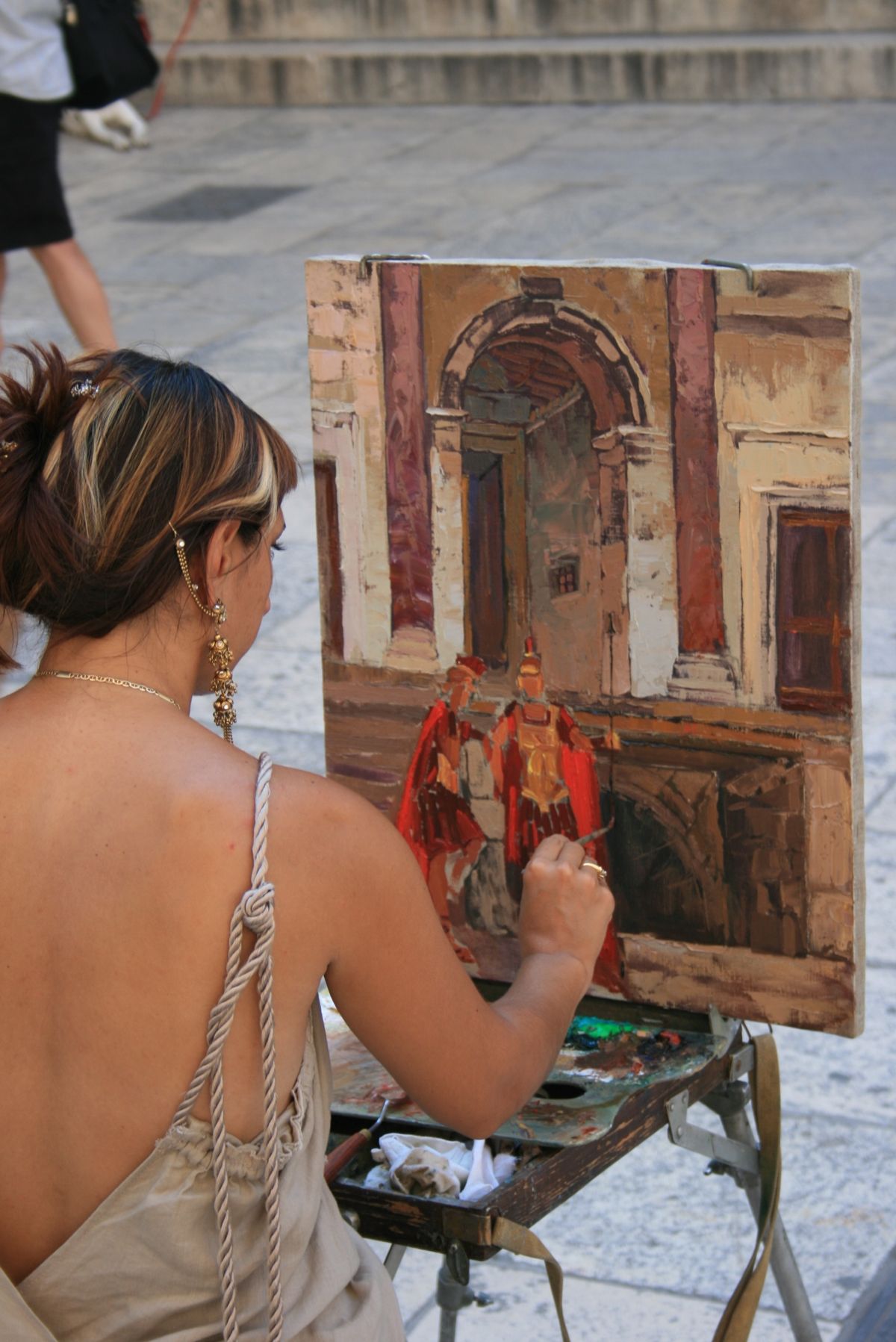
A painter at her easel in Split's old town, painting Roman soldiers in front of the palace

Tours and getting around

See more on a day trip

Split is the easiest place to start a day trip: by boat to Hvar, Brač or the Blue Cave on Biševo, by road to Krka National Park or Trogir, or rafting on the Cetina river near Omiš. In the old town, walking tours cover the palace's history and its Game of Thrones filming spots.

You won't need a car in the city; the old town is pedestrian and parking is limited. Rent one for day trips to Krka, Trogir or Klis, or a scooter for the beaches. To reach the islands on your own schedule, rent a boat, with or without a skipper.

  • Trogir

    About 30 minutes by car or bus

    A small walled town on an islet, also UNESCO-listed, with a fine cathedral portal and a waterfront lined with yachts.

  • Klis Fortress

    About 20 minutes by car

    A medieval fortress on a ridge above Split, used as Meereen in Game of Thrones, with wide views to the coast.

  • Krka National Park

    About an hour by car

    Waterfalls and wooden walkways through the river canyon; go early in summer.

  • Brač

    50 minutes by ferry

    Supetar is the closest island town; Bol and the Zlatni Rat beach are an hour's drive across the island or a direct catamaran.

  • Hvar

    About an hour by catamaran

    Hvar Town's harbour, fortress and lanes make an easy day by catamaran.

  • Vis

    Ferry or catamaran

    The farthest of the central islands, wilder and quieter; better for a night or two than a rushed day.

  • Omiš and the Cetina river

    About 30 minutes by car

    Rafting, canyoning or a zipline in the canyon behind the little town of Omiš.

Common mistakes

  • Driving into the centre. Leave the car outside or skip it altogether while you are in the city.
  • Seeing the palace only at midday. Come early or after dark, when it is quieter and cooler.
  • Leaving ferry tickets to the last minute in July and August, especially with a car.
  • Wearing beachwear into the cathedral. Cover your shoulders and knees.
  • Assuming every catamaran runs all year. Check winter timetables before you plan an island day.
  • Staying inside the palace walls with light sleepers or small children. Varoš, Meje or Žnjan are calmer.

Frequently asked questions

Is Split worth visiting?

Yes. Few places let you live inside a Roman palace, swim in town and catch a ferry to an island in the same day. It is also one of the easiest bases on the coast if you don't have a car.

How many days do you need in Split?

Two days for the city itself, three or four with day trips. If you are island hopping, one night at the start or end is enough.

Do I need a car in Split?

Not in the city. The centre is pedestrian and parking is limited. Rent one only for day trips to Krka, Klis or Trogir, or use buses and tours.

How do I get from Split Airport to the city centre?

Take the airport shuttle bus to the main bus station by the port (30–40 minutes), local bus 37 or 38 (cheaper but slower), or a taxi or ride-hailing car (about 30 minutes).

Is Diocletian's Palace free?

Yes, the palace streets, the Peristyle and the central cellar passage are free and open all day and night. The cathedral, bell tower, side cellar halls and Temple of Jupiter have separate tickets.

What is the best beach in Split?

Bačvice for sand, shallow water and atmosphere; Kašjuni below Marjan for clearer water and fewer people; Žnjan for a long beach with space for families.

Should I stay in Split or on Hvar?

Stay in Split for city life, food and easy transport, and on Hvar for a slower island holiday. Many people do two nights in Split and two or three on an island.

Can you take a ferry from Split to Dubrovnik?

Yes, in season. Passenger catamarans run along the coast via Hvar and Korčula, and some also stop on Mljet. It takes longer than driving but is the more scenic way.

Where to next

One email a month from Croatia

New guides, ferry news and tips from locals, expats and the Croatian diaspora. No spam, unsubscribe anytime.